Retro Ribbons: Injecting Vintage Soul into Modern Design
There is a specific kind of nostalgia that hits you when you see a vintage soda label or a classic diner menu. It’s not just about the colors; it’s about the typography that holds the imagery together. If you are a designer, small business owner, or creative entrepreneur looking to capture that timeless, textured aesthetic, you know how difficult it is to find a typeface that feels authentic rather than just "old-timey." Enter Retro Ribbons. This isn't just another display font; it is a comprehensive design system built to bring depth, character, and a distinct mid-century charm to your projects. With its unique ribbon-like dimensional quality and accompanying doodle elements, it bridges the gap between vintage illustration and modern digital utility.
The Visual Language of Dimension and Texture
What sets Retro Ribbons apart from standard serif or sans serif options is its inherent three-dimensional quality. When we talk about typography, we usually discuss flat shapes on a page. However, this typeface mimics the look of folded paper or woven fabric, creating a visual depth that standard flat fonts cannot achieve. It functions as a high-quality premium font that serves as a focal point in any composition. The style leans heavily into the "Americana" aesthetic—think 1950s signage, vintage badge designs, and classic tattoo art. It is a creative font that demands attention, making it perfect for headlines, logos, and branding elements where you need to make an immediate impact.
Beyond the standard letterforms, the inclusion of specific file formats like OTF and TTF ensures that you have full control over kerning and ligatures, which is crucial when working with a display font that relies on spacing to maintain its legibility. For those working on tablets, the ProcreateFont compatibility is a massive advantage. It allows illustrators and lettering artists to sketch out concepts directly on their iPads, ensuring that the workflow from rough draft to final vector remains seamless. Whether you are using Affinity Designer Font capabilities for vector work or Affinity Photo Font features for raster-based mockups, the file versatility ensures this asset fits into your existing ecosystem without friction.
Strategic Branding and Logo Applications
For small business owners and entrepreneurs, choosing a font is a strategic decision, not just an aesthetic one. Your typography tells your audience who you are before they read a single word. Retro Ribbons communicates authenticity, craftsmanship, and a connection to tradition. This makes it an exceptional choice for businesses in the food and beverage industry, barbershops, craft breweries, and artisanal goods. If your brand identity relies on a "handmade" or "heritage" narrative, this typeface anchors that message visually.
When using this font for logo design, it is important to consider the silhouette. Because the font has a distinct shape and texture, it pairs beautifully with clean, geometric sans serif fonts. Use Retro Ribbons for the primary brand name to establish personality, and pair it with a neutral sans serif for taglines or sub-information to ensure readability. This contrast creates a hierarchy that guides the viewer’s eye naturally. It is a commercial font that works hard for your brand identity, turning a simple name into a memorable emblem.
Expanding the Toolkit: Dingbats and Coloring Outlines
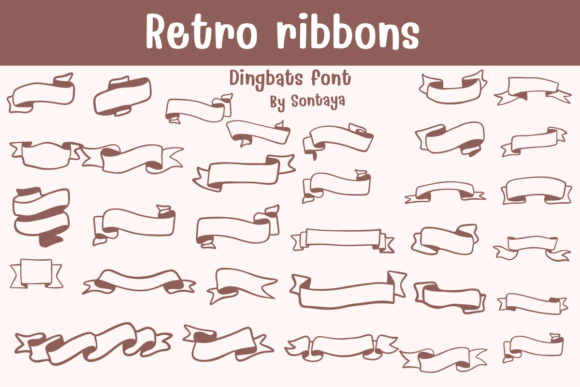
A typeface is often judged by its glyphs, but Retro Ribbons offers much more than just letters. One of the most practical features for designers and crafters is the inclusion of Dingbats and Doodle Cartoon elements. These are not afterthoughts; they are essential design assets that allow you to build entire compositions using a single font family. You can create borders, corner flourishes, and thematic illustrations that perfectly match the weight and texture of the text.
Furthermore, the Coloring Outline variation is a game-changer for product creators. If you are designing merchandise, t-shirts, or even digital planners, having a clean outline version allows for easy color customization. For crafters using cutting machines or screen printers, this outline version ensures that the intricate details of the ribbon effect are preserved while allowing for multi-color applications. This versatility transforms the font from a simple text tool into a robust illustration kit, ideal for creating stickers, patches, and custom stationery.
Practical Application Across Digital and Print Media
The utility of Retro Ribbons extends across a wide variety of mediums. In the realm of packaging design, this font shines. It can be used to create "flash" style labels that pop off the shelf. Whether you are designing a coffee bag or a hot sauce bottle, the font provides that instant recognition of quality. For editorial design, such as magazine covers or book titles, it adds a layer of intrigue and genre-specific flavor, particularly for history, cooking, or lifestyle publications.
For social media graphics, where attention spans are short, the bold nature of this display font helps stop the scroll. It is excellent for Instagram stories, YouTube thumbnails, and Pinterest pins where you need to convey a message quickly and stylishly. In web design, it should be used sparingly—typically for H1 headers or hero section text—to maintain fast load times and readability, while using a standard web font for body text. This approach ensures your site looks professional and loads efficiently.
Technical Considerations and Workflow Integration
Adopting a new font into your workflow requires some technical awareness. When working with Affinity Photo or Affinity Designer, ensure that you are utilizing the OpenType features to access alternate characters and swashes. These subtle variations can make the difference between a generic layout and a custom-looking design. For digital product creators, such as those selling printable planners or wall art, the commercial licensing of the font is a critical factor. Always verify that your license covers the end product you intend to sell.
Testing font pairings is another essential step. While Retro Ribbons is a powerhouse on its own, it needs a supporting cast. Try pairing it with a clean script font for a more elegant, wedding-invitation vibe, or stick to a bold sans serif font for a more industrial, work-wear aesthetic. The goal is to balance the ornate nature of the ribbon font with something that offers visual rest. By treating Retro Ribbons as the star of the show and giving it the right context, you ensure that your designs remain legible, professional, and emotionally resonant with your target audience.